
Rethinking the Question
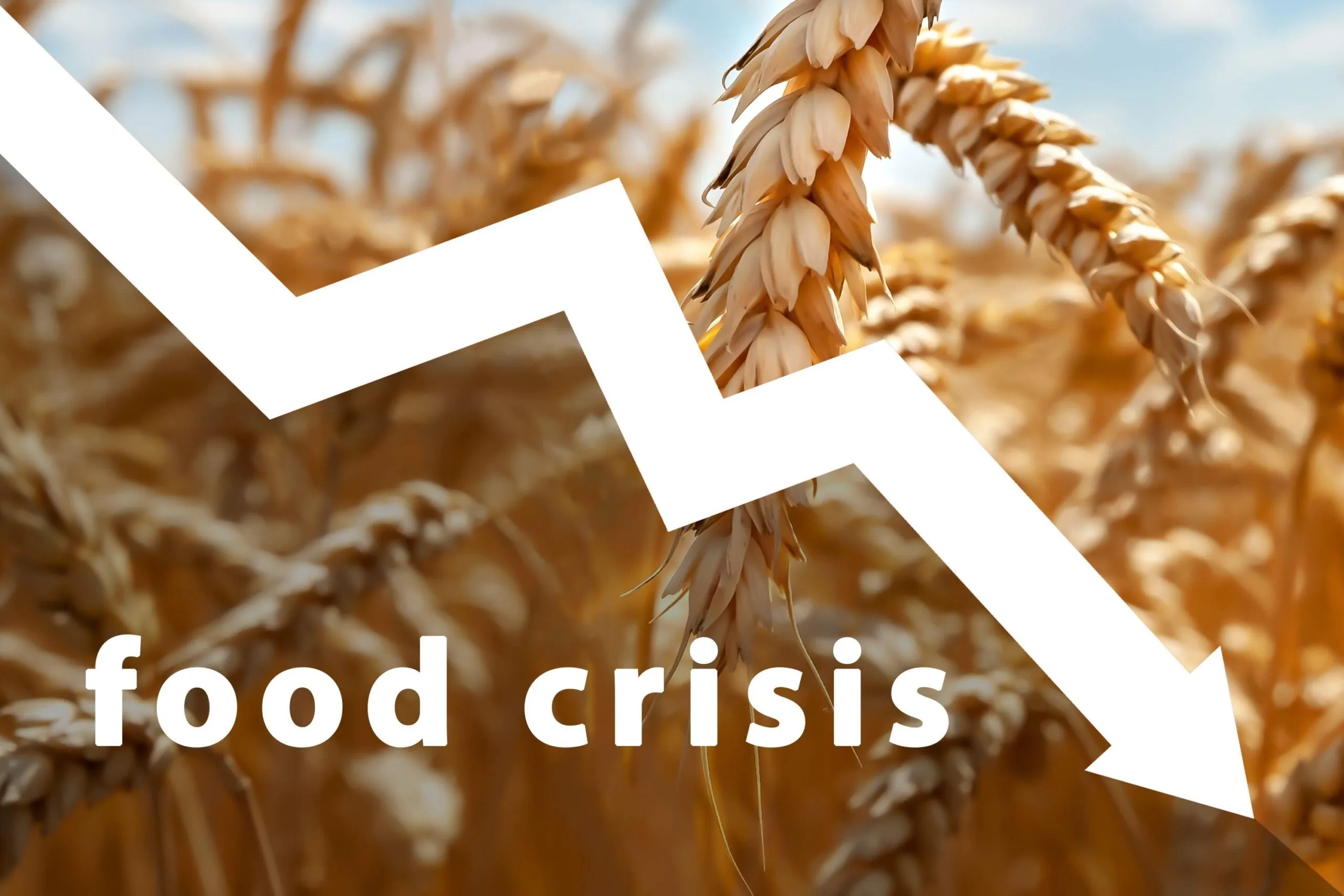
Since 2009, the world has been stuck on a single narrative around a coming global food crisis and what we need to do to avoid it.
The question is always the same:
How do we feed nine billion people by 2050?
Every conference, podcast, and dialogue around global food security starts with this question and usually arrives at the same answer: we need to produce 70 percent more food.
The 2050 narrative began to evolve shortly after global food prices hit all-time highs in 2008. People were suffering and struggling. Governments and world leaders needed to show that they were paying attention and working to solve the problem.
The thing is, 2050 is so far into the future that we can barely relate to it. More importantly, if we keep doing what we’re doing, the crisis is going to hit us a lot sooner than that.
I believe we need to ask a different question.
The answer to that question also needs to be framed differently.
If we can reframe the old narrative and replace it with new numbers that tell a more complete story—numbers that everyone can understand and relate to—we can avoid the crisis altogether.
Understanding the Tipping Point
In a past life, I was a commodities trader. One of the things I learned from trading is that every market has a tipping point—the moment when change occurs so rapidly that it impacts the world and things change forever.
Think of the last financial crisis or the dot-com crash.
Here’s my concern:
We could face a tipping point in global food and agriculture if surging demand surpasses the agricultural system’s structural capacity to produce food.
At that point, supply can no longer keep up with demand, despite exploding prices, unless we commit to some form of structural change.
This time, it won’t be about stock markets and money.
It’s about people.
People could starve, and governments may fall.
The question of when supply begins to struggle against surging demand started as an interest for me while I was trading. Eventually, it became an obsession.
It became an obsession when I realized, through my research, how broken the system was and how little data was being used to make such critical decisions.
That’s when I decided to walk away from a career on Wall Street and begin an entrepreneurial journey by founding Gro Intelligence.
At Gro, we focus on bringing together data and making it actionable, empowering decision-makers at every level.
While doing this work, we also realized that the world—not just world leaders, but businesses and ordinary citizens like every person in this room—lacked an actionable guide for avoiding a global food security crisis.
So we built a model using the petabytes of data we sit on, and we solved for the tipping point.
No one knew we had been working on this problem, and this is the first time I’m sharing what we discovered.
The Shocking Discovery
We discovered that the tipping point is actually a decade away.
We discovered that the world will be short 214 trillion calories by 2027.
The world is not currently in a position to fill this gap.
You’ll notice that the way I’m framing this problem is different from how I started, and that’s intentional.
Until now, this challenge has been quantified using mass—kilograms, tons, hectograms, or whatever unit of weight you prefer.
Why do we talk about food in terms of weight?
Because it’s easy.
We can estimate tonnage on a ship using a simple calculator. We can weigh trucks, airplanes, and even oxcarts.
But what we actually care about in food is nutritional value.
Not all foods are created equal, even if they weigh the same.
I learned this firsthand when I moved from Ethiopia to the United States for university.
When I returned home, my father, excited to see me, greeted me by asking why I was fat.
As it turns out, eating approximately the same amount of food as I did in Ethiopia—but in America—had given me a certain fullness in my figure.
This is why we should care about calories, not mass.
Calories sustain us.
What Does 214 Trillion Calories Look Like?
Now, 214 trillion calories is an enormous number, and even the most dedicated among us don’t think in terms of hundreds of trillions of calories.
So let me explain it differently.
Let’s think in Big Macs.
A single Big Mac contains 563 calories.
That means the world will be short 379 billion Big Macs in 2027.
That’s more Big Macs than McDonald’s has ever produced.
How Did We Get Here?
These numbers aren’t made up.
Looking at global net calorie gaps over the past 40 years tells a remarkable story.
A net calorie gap is simply:
Calories consumed in a country minus calories produced in that same country.
This isn’t a statement about malnutrition. It’s simply a measure of consumption versus production.
Countries shown in blue are net calorie exporters or self-sufficient. They produce more calories than they consume.
Countries shown in red are net calorie importers. The brighter the red, the greater the dependency on imports.
Forty years ago, very few countries were net exporters of calories—I could count them on one hand.
Most of Africa, Europe, much of Asia, and South America (excluding Argentina) were net importers.
What’s especially surprising is that China was food self-sufficient, while India was a major net importer of calories.
Fast forward 40 years, and the world looks dramatically different.
Brazil has emerged as an agricultural powerhouse.
Europe has become dominant in global agriculture.
India has moved from red to blue and become food self-sufficient.
China, meanwhile, has gone from light blue to the brightest red on the map.
So what happened?
India, Africa, and China: Three Different Paths
Consider India and Africa.
Both started from similar positions and followed similar trajectories.
Yet they ended up on very different paths.
The key difference?
India experienced a Green Revolution.
No African country did.
The result is clear:
India became food self-sufficient and, over the past decade, has even exported calories.
Africa, by contrast, now imports more than 300 trillion calories every year.
Then there’s China.
China followed a path similar to India’s until the beginning of the 21st century, when everything changed.
A young and growing population, combined with rapid economic growth, transformed China’s food demand almost overnight.
No one in the markets saw it coming.
This shift changed global agricultural markets forever.
Fortunately, South America was beginning its agricultural boom at the same time China was rising, helping keep supply and demand somewhat balanced.
What Happens Next?
The future isn’t a new story.
It’s a continuation of China, an amplification of Africa, and a paradigm shift in India.
By 2023, Africa’s population was forecast to overtake those of India and China.
Together, these three regions would account for more than half of the world’s population.
This demographic shift presents enormous challenges for global food security.
A few years later, those challenges become impossible to ignore.
India
India has remained food self-sufficient, and most forecasts suggest this will continue.
We disagree.
India will soon become a net importer of calories.
This shift will be driven by population growth and economic growth. Even under optimistic assumptions about production growth, India still makes that transition.
And even a small shift can have enormous implications.
Africa
Africa will continue to be a net importer of calories, again driven by population and economic growth.
This projection also assumes optimistic production growth.
China
China’s population growth may be flattening, but calorie consumption will continue to rise.
As incomes increase, people consume more calorie-dense foods.
Together, India, Africa, and China create a challenge unlike anything the world has faced before.
The 214-Trillion-Calorie Deficit
Until now, countries facing calorie deficits have compensated by importing food from surplus regions.
Those surplus regions are primarily North America, South America, and Europe.
Production in these regions is expected to continue growing over the next decade.
However, most of that growth is projected to come from South America, and much of it will come at the cost of deforestation.
When we compare the combined demand growth of India, China, and Africa with the projected production increases from India, China, Africa, North America, South America, and Europe, we are left with a deficit of 214 trillion calories.
A deficit we simply cannot produce.
And this calculation assumes that every additional calorie produced in North America, South America, and Europe is exported exclusively to India, China, and Africa.
What I’ve just described is a vision of an impossible world.
But we can change it.
Three Possible Solutions
We can:
- Change consumption patterns.
- Reduce food waste.
- Make a bold commitment to increasing agricultural yields exponentially.
I won’t spend time discussing consumption changes or food waste.
Those conversations have been happening for years.
Nothing significant has happened because these arguments ask surplus regions to change their behavior on behalf of deficit regions.
Waiting for others to change their behavior for your survival is a terrible strategy.
It’s unproductive.
Instead, I’d like to suggest an alternative—one that comes from the deficit regions themselves.
Why the Solution Lies in India and Africa
China faces severe constraints.
It has limited agricultural land available for expansion and significant water resource challenges.
That leaves India and Africa.
India still has room for yield improvements—the gap between current productivity and theoretical maximum productivity.
It also has some remaining arable land, though not much.
India is heavily land-constrained.
Africa, however, is different.
The continent possesses vast amounts of available arable land and significant potential for yield growth.
To simplify the picture, corn yields in sub-Saharan Africa today are roughly where North American yields were in 1940.
The problem is that we don’t have another 70 years to figure this out.
We need new solutions, and we need them now.
The Case for Agricultural Commercialization
The solution begins with reform.
We need to reform and commercialize agricultural industries in Africa and India.
Commercialization is not simply about large-scale farming.
It means leveraging data to create better policies, improve infrastructure, lower transportation costs, and reform banking and insurance systems.
Commercialization means transforming agriculture from a risky endeavor into one where fortunes can be made.
It’s not just about farmers.
It’s about the entire agricultural ecosystem.
At the same time, we must acknowledge that we can no longer place the burden of growth solely on small-scale farmers.
Commercial farms can provide economies of scale that benefit smaller farmers as well.
This is not a choice between small-scale farming and commercial agriculture.
We can build successful models where both coexist and thrive.
For the first time in history, the industry’s most important asset—data and knowledge—is becoming cheaper every day.
Soon, success won’t depend primarily on how much money you have or how large your operation is.
It will depend on your ability to make optimal decisions and maximize your chances of success.
Companies like Gro are working hard to make this vision a reality.
A New Path Forward
If we commit to this bold new direction, we can do more than close the 214-trillion-calorie gap.
We can put the world on an entirely new trajectory.
India can remain food self-sufficient.
Africa can emerge as the world’s next major food-surplus region.
So perhaps the new question should be:
How do we produce 214 trillion calories to feed 8.3 billion people by 2027?
We have the solution.
We just need to act on it.