
The Busy Beauty of Harvest Season
We’re in the thick of harvesting season. Everything in the garden seems to be ready all at once.
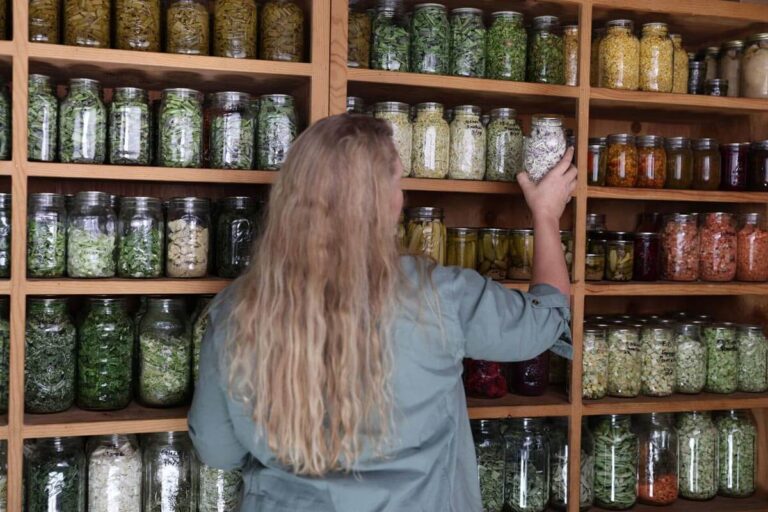
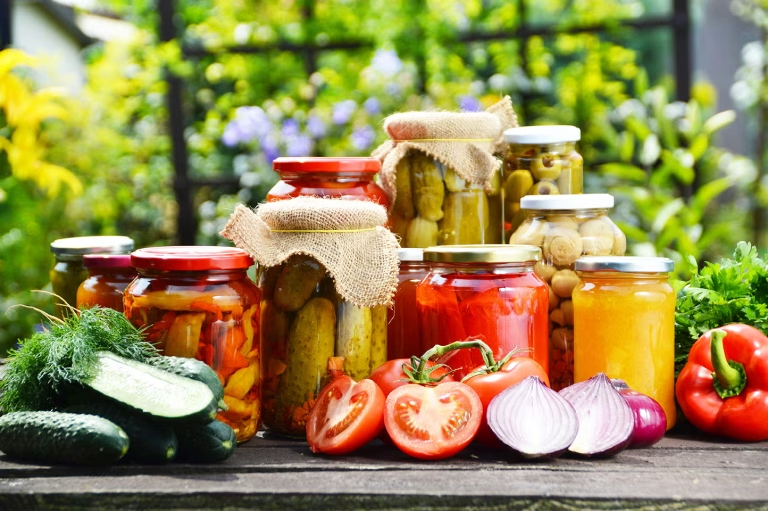
This is the time of year when we hunker down, stay home as much as possible, and focus all of our attention on preserving the food that nature is giving us. Nature is so lavish and generous, and I’m especially aware of it during harvest season.
I buried ten tomato seeds in the ground, and in return I’m receiving bushels of tomatoes. I feel rich, blessed, and so fulfilled.
Drowning in Garden Produce
I am absolutely drowning in garden produce right now.
My tomatoes are at their peak, so I’m getting bushels of them. Thankfully, I can simply pop them in the freezer and avoid having multiple small canning days throughout tomato season. Instead, I can do a few really large canning sessions.
My all-time favorite way of preserving food is curing it and storing it in a cold room. I enjoy a little bit of canning here and there, and I find some joy in the process. However, it can also become overwhelming for me because I don’t particularly love spending time in the kitchen.
That’s just who I am. I love being outside. I love growing the food. What I don’t love as much is processing it in the kitchen. For me, curing food and storing it in the cold room without all the extra kitchen steps is a really awesome system.
The Foundation of Our Self-Sustainable Homestead
The foundation of what we grow to be self-sustainable here on our homestead includes:
- White potatoes
- Sweet potatoes
- Onions
- Garlic
- Carrots
Carrots can’t be cured, but they can simply be stored in a refrigerator. They don’t require a lot of kitchen processing to preserve them for winter.
Right now, my tomatoes are filling up the table where I previously had onions curing.
We currently have:
- White potatoes curing in our cold room
- A large batch of onions in the middle of the curing process
- More onions waiting to be brought in and cured
Today, I’ll take you along and show you the onion-curing process.
I’m not going to have time to can these tomatoes today, but I may do that in a future video if you’re interested in tomato recipes and tomato canning.
A Sudden Change in Weather
Last week it felt like a sauna outside—hot and humid.
This week is completely different. It’s windy, chilly, and temperatures are in the 50s. It feels surprisingly cold.
The onions we’re working with today were pulled about two weeks ago and are now brown and crunchy.
How We Cure Onions for Long-Term Storage
The onion tops have dried out completely and become brown and crispy.
I simply cut off the tops while leaving a small stub. You don’t want to cut all the way down to the onion. Leave about an inch to an inch and a half attached.
Important Onion Curing Tips
When laying out onions to cure:
- Keep them out of direct sunlight.
- Protect them from rain and moisture.
- Allow plenty of airflow.
Some people cure onions in direct sunlight, but I’ve found that it can make them turn slightly green. Personally, I prefer curing them in a bright area without direct sun exposure.
After trimming, I allow the onions to continue curing for another two weeks, making the total curing period approximately four weeks.
This additional curing time allows any remaining moisture in the neck of the onion to dry completely.
The Secret to Long-Lasting Onions
Proper curing is the secret to onions lasting for months.
Last year, our onions stored for a full nine months without sprouting, which was incredible.
I like to tidy them up a bit, but I never remove too much of the papery outer layer. That papery skin helps protect the onions and extend their storage life throughout the winter.
Smaller onions are set aside for recipes such as:
- Marinara sauce
- Barbecue sauce
- Salsa
The larger onions are ideal for long-term storage.
Harvesting More Onions
While some onions were pulled two weeks ago, the remaining onions weren’t ready at the same time.
Once the tops have bent over and remained down for at least a week, they’re generally ready to harvest.
Because we planted different onion varieties at different times, they matured at different rates.
The recent rain left the soil slightly damp, but these onions will dry quickly on the porch.
The leaf mulch does an excellent job of holding moisture in the soil.
Raspberry Season Continues
Our raspberries are still producing heavily.
They’ll continue until the weather becomes much colder. Production has slowed slightly because the nights have cooled down, but they’re still going strong.
Surviving Harvest and Preserving Season
Harvest and preserving season can become overwhelming if you’re not prepared, but it’s also incredibly rewarding.
One of our biggest strategies is simply staying home.
If we leave for even a weekend, we often return to a garden full of overripe produce. Things can get out of hand very quickly.
My number one strategy for managing harvest season is staying on top of the produce as it comes in. If I don’t, I end up wasting food and feeling overwhelmed.
Fortunately, the busiest part of preserving season only lasts a few weeks. It arrives in a wave and gradually tapers off. I try my best to enjoy it while it lasts.
Preserving Raspberries the Easy Way
I had a smaller raspberry harvest today.
Since I don’t have time to process them immediately, I’m simply placing them in a freezer bag for smoothies.
I’ve been experimenting with lots of raspberry recipes this year because we still have plenty of raspberry jam left from last season.
Raspberry Kvass
One of my newest experiments is raspberry kvass.
It’s made using:
- Raspberry pulp leftover from lemonade concentrate
- Honey
- Water
- A pinch of salt
The mixture ferments on the counter for a few days and becomes fizzy while developing beneficial bacteria. I’m really excited about it.
Raspberry Lemonade Concentrate
I’ve also been canning large amounts of raspberry lemonade concentrate.
It’s delicious, and I think it would make a wonderful Christmas gift paired with a bottle of sparkling water.
A Quick Homestead Project Update
While Michelle finished laying out onions, I wanted to show a quick update on my office project.
The exterior is nearly complete:
- Siding is finished
- Windows are installed
- Exterior looks great
Next steps include:
- Insulating the roof
- Installing electrical
- Insulating the walls
- Drywall
- Trim
- Flooring
Then it will finally be finished.
Well… mostly finished.
Growing Dry Beans for Food Security
This year we’re excited to harvest something we haven’t grown in several years: dry beans.
We’re growing three varieties:
- Black Turtle Beans
- Red Kidney Beans
- Tiger’s Eye Beans
Many of these plants are already completely dried out and ready to harvest.
We’re pulling them up and laying them out to dry before shelling.
Because the pods are extremely dry, we have to walk carefully through the rows. If you step on a pod, beans can scatter everywhere.
Simplifying Preserving Season
During peak preserving season, I intentionally simplify things as much as possible.
I’ve learned the hard way that stress and overwhelm are very hard on my health.
If preserving season overwhelms you too, I encourage you to simplify wherever possible.
Growing and preserving food is important. It’s worth protecting your enjoyment of it.
Why We Like Growing Dry Beans
Dry beans are one of the easiest staple crops we’ve ever grown.
Benefits include:
- Minimal pest problems
- Minimal disease pressure
- Long storage life
- Little processing required
Once they’re fully dry, they can be stored for years in airtight containers.
- No canning.
- No freezing.
- No complicated preservation methods.
That’s one reason I wanted to grow them again this year—an extra layer of food security with very little effort.
Keeping Food Preservation Practical
One way I simplify harvest season is by minimizing canning and freezing whenever possible.
- I’m not the person who cans everything.
- I don’t can french fries.
- I don’t can dried beans.
- I don’t freeze-dry entire casseroles.
Those methods aren’t wrong—they’re simply not my style.
For example, dry beans can remain perfectly usable for years in airtight storage. Instead of pressure canning them during the busiest part of summer, I’d rather cook them fresh in my Instant Pot during the slower winter months.
I take the same approach with:
- Potatoes
- Squash
- Sweet potatoes
- Carrots
The only time I preserve cold-room produce further is when I think it may spoil before we can eat it.
Our First Pear Harvest
Perhaps the most exciting harvest we’ve ever had on the homestead this year is pears. We’ve never harvested pears before.
Unfortunately, our apple trees suffered from disease this season and produced no usable apples. The fruit shriveled and disappeared.
Thankfully, our pear trees performed much better, most of the pears aren’t ready yet, but a few are ripe.
They’re absolutely delicious, some have minor insect damage, but they’re still wonderful.
The satisfaction of eating fruit that we grew ourselves is hard to describe.
We’re not expecting a huge pear harvest this year, but we’re hopeful that better tree care and nutritional sprays may increase production next season.
Ending the Day with Bean Processing
After supper and a quick shower, we headed back outside.
Our goal was simple:
Pull as many bean pods off the plants as possible while keeping each variety separate.
This will likely take another day or two to finish.
For me, harvest season is busy and intense, while winter is much slower.
Because of that, I’d rather save many food-processing tasks for winter.
I can throw dried beans into the Instant Pot on a slow January afternoon far more easily than pressure can them during the busiest week of August.
Once all the pods have been removed, we’ll spread the beans out in a single layer somewhere dry and allow them to continue drying for another week or two before shelling them.
We’ll come back and show that process in a future update.
Final Thoughts
Harvest season is one of the busiest times of the year on the homestead, but it’s also one of the most rewarding.
The abundance can feel overwhelming at times, but staying home, simplifying preservation methods, and focusing on practical food storage systems helps us manage it all.
For us, preserving food isn’t just about stocking a pantry—it’s about honoring the generosity of nature and making the most of the harvest we’ve been blessed with.